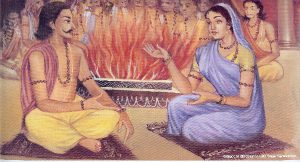
Rig Veda 8.33.17 is being quoted very often as the representation of the status of women in ancient India. Many translators like Griffith or Wilson, translated the verse as Indra stating that "the mind of a woman is not to be controlled" or that "her intellect is small," indicating misogynistic attitude in the ancient Indian society.
——
The Rik Rig Veda 8.33.17, reads as follows:
इन्द्रश्चिद्घा तदब्रवीत्स्त्रिया अशास्यं मनः । उतो अह क्रतुं रघुम् ॥
indraś cid ghā tad abravīt striyā aśāsyam manaḥ | uto aha kratuṃ raghum ||
English translation:
Indra said just this, “the mind of woman is not to be instructed, and her will is fickle (quickly changing).
——
The ideas expressed in Rig Veda will represent various spiritual aspects. And, unless one start viewing the Riks of Rig Veda in esoteric sense, they bound to baffle the reader.
—-
In the minds of Rig Vedic rishis, wife or woman represented, in esoteric sense, the Sādhana (साधन) or spiritual practice.
If we replace the word woman with Sādhana (साधन) or spiritual practice, we will get the right meaning of the Rik, which is as follows.-
—-
Indra (the DIVINE illumination) said just this, “the Sādhana (साधन) or spiritual practice is not to be controlled, and it is fickle (quickly changing).
—-
Hence, the rishi is conveying that Sādhana (साधन) or spiritual practice is not steady and quickly changing.

No comments:
Post a Comment