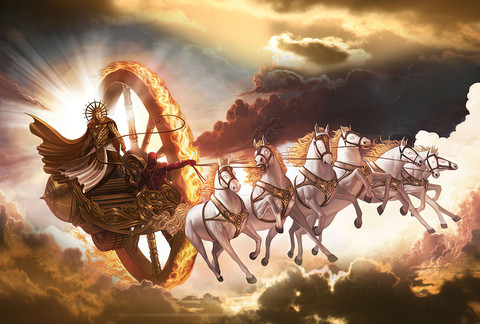
The prevalent meaning of Surya’s chariot having 7 horses is varied.
Some symbolise the seven horses of Surya with
- the seven colors of visible light (VIBGYOR),
- the seven days of the week, and
- the seven Vedic meters (Chandas) of poetry, representing divine energy, time, and cosmic order
——
The earliest reference to Surya’s 7 horses can be found in Rig Veda.
——
आ सूर्यो यातु सप्ताश्वः क्षेत्रं यदस्योर्विया दीर्घयाथे । रघुः श्येनः पतयदन्धो अच्छा युवा कविर्दीदयद्गोषु गच्छन् ॥
ā sūryo yātu saptāśvaḥ kṣetraṃ yad asyorviyā dīrghayāthe | raghuḥ
śyenaḥ patayad andho acchā yuvā kavir dīdayad goṣu gacchan ||
English translation:
Let the Surya drive here with his seven horses to the tract of land stretching widely at (the end of) his long course. Let the quick falcon fly to the stalk and the youthful poet shine as he goes among the cows.
——
Rig Veda is a pure spiritual treatise, conveyed in esoteric sense, by the rishis (seers) of that era. The Rig Vedic seers/sages had different spiritual connotation in their mind from that of above mentioned/puranic explanations, while describing Surya’s chariot with 7 horses.
The basic premise of spirituality is that the practitioner should
- purify one’s mind by following 7 types of self-purifying practices,
- overcome the obstacles in spiritual path, and
- realise the hidden Illumination within oneself , with the grace of the BRAHMAN.
In esoteric sense, the formless BRAHMAN/ENERGY was mentioned Surya and those 7 types of self-purifying practices are 7 horses of Surya, through which ONE will realise the BRAHMAN.
—-
The 7 types of self-purifying practices were not explicitly mentioned in Rig Veda. I am listing the following 7 types of self-purifying practices, as per my understanding.
- Ahimsā (अहिंसा): non-harming other living beings
- Satya (सत्य) : To be on the path of TRUTH with trikāraṇaśuddhi (त्रिकारणशुद्धि) - purification or harmony of three instruments: thoughts (manas), words (vacha), and actions (karman)
- Asteya (अस्तेय) : non-stealing with trikāraṇaśuddhi (त्रिकारणशुद्धि)
- Aparigraha (अपरिग्रह) - non-possessiveness (not accumulating/keeping more than required) with trikāraṇaśuddhi (त्रिकारणशुद्धि)
- Tapas (तपस्): persistence, perseverance, austerity,
- Svadhyaya (स्वाध्याय) : study of self, self-reflection, introspection of self's thoughts, speech and actions
- Santosha (संतोष) : contentment, acceptance of one's circumstances as they are
———
In the esoteric language of Rig Veda, the word water indicates light/wisdom/energy. Similarly, the word vṛtra does not indicate a serpent/demon, but indicates obstacles in the path of a spiritual practitioner, while Indra/Brihaspati/Sarasvatī is the BRAHMAN, who removes those obstacles and so that the hidden light/wisdom within oneself will flow.
- the hidden DIVINE Illumination was described as Sun/water getting captured and concealed by Vrtra/Panis/Bṛsaya
- conquering of one’s own weaknesses was described as elimination of Vrtra/Panis/Bṛsaya by Indra/Brihaspati/Sarasvatī, etc, and
- realising the hidden Illumination within oneself or attaining of SELF REALISATION was described as releasing of concealed waters/Sun, from a CAVE, etc.
—-
a) Release of Sun/DIVINE ILLUMINATION
त्वमपामपिधानावृणोरपाधारयः पर्वते दानुमद्वसु । वृत्रं यदिन्द्र शवसावधीरहिमादित्सूर्यं दिव्यारोहयो दृशे ॥
tvam apām apidhānāvṛṇor apādhārayaḥ parvate dānumad vasu | vṛtraṃ yad indra śavasāvadhīr
ahim ād it sūryaṃ divy ārohayo dṛśe ||
English translation:
You opened up the covers of the waters; you held fast to the drop-laden goods in the mountain. When, o Indra, with your vast power you smashed the serpent Vr̥tra, just after that you made the sun rise in heaven to be seen.
b) Release of waters
अदर्दरुत्समसृजो वि खानि त्वमर्णवान्बद्बधानाँ अरम्णाः । महान्तमिन्द्र पर्वतं वि यद्वः सृजो वि धारा अव दानवं हन् ॥
adardar utsam asṛjo vi khāni tvam arṇavān badbadhānām̐ aramṇāḥ | mahāntam indra
parvataṃ vi yad vaḥ sṛjo vi dhārā ava dānavaṃ han ||
English translation:
You violently split the wellspring; you reamed out its apertures. You brought to peace the floods, which had been hard pressed. When, Indra, you pried apart the great mountain, you set loose the streams; you smashed down the Dānava.
After realising the hidden illumination within oneself, one will be treated as having 2nd birth - द्विजन्मा -dvijanmā , and thus one will become a द्विज - Dvija.
अभि द्विजन्मा त्री रोचनानि विश्वा रजांसि शुशुचानो अस्थात् । होता यजिष्ठो अपां सधस्थे ॥
abhi dvijanmā trī rocanāni viśvā rajāṃsi śuśucāno asthāt | hotā
yajiṣṭho apāṃ sadhasthe ||
English translation:
Possessing two births he has surmounted the three luminous realms, blazing through all the airy spaces—the best sacrificing Hotar in the seat of the waters.
---
After this re-birth, ONE becomes a dvija.

No comments:
Post a Comment